
Pet Travel Container Requirements
What an airline-compliant travel crate must meet for international pet relocation.
Based on IATA Live Animals Regulations, Edition 52, January 2026
1. Overview
Every dog or cat travelling internationally by air must be shipped in a container that meets the International Air Transport Association's Live Animals Regulations (LAR) — specifically Container Requirement 1, which covers dogs and cats travelling in the aircraft hold, and the related In-Cabin requirement for animals small enough to travel with their owner in the cabin.
This page summarises those requirements in plain language so you know what to expect before you buy or build a travel crate. It is a guide, not a substitute for the full regulations — airlines and destination countries can apply additional rules, and our team checks every container against the specific route before travel.
2. Materials & Construction
- Allowed materials: fiberglass, metal, rigid plastic, welded wire mesh, solid wood or plywood.
- Wood used for international transport must comply with IPPC wood-packaging standards.
- A container made entirely of wire mesh is not acceptable on its own — it must be paired with solid sides as described below.
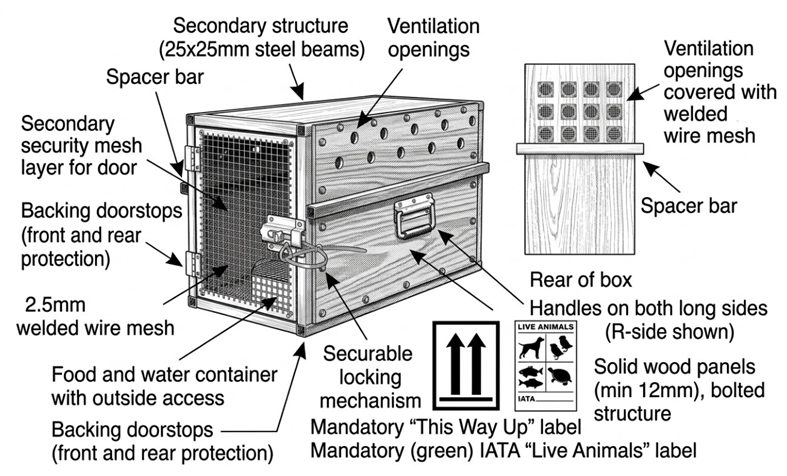
- Welded wire mesh must be at least 2.5 mm thick for dogs and 2.0 mm thick for cats.
- The interior must be smooth, with no protrusions the animal can bite or scratch.
- All openings must be nose- and paw-proof: a maximum of 25 mm × 25 mm for dogs and 19 mm × 19 mm for cats, smaller if needed to prevent injury.
- Wheels, if fitted, must be removed or locked so the container cannot roll.
3. Sizing the Container
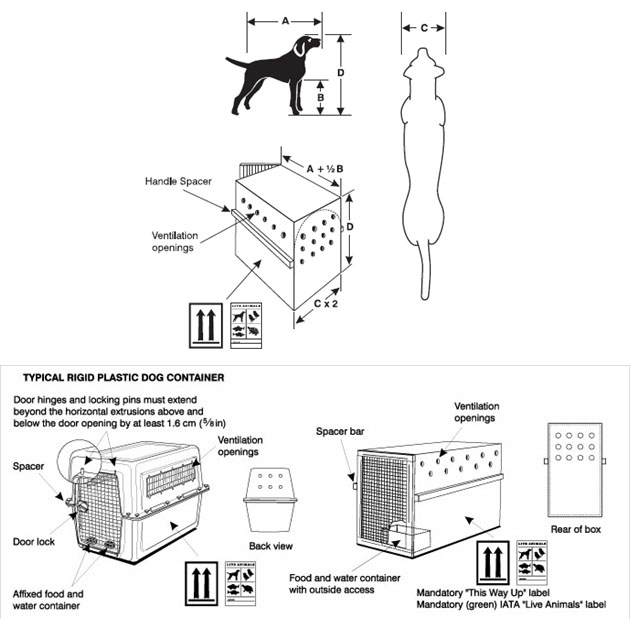
The animal must be able to stand, sit erect, lie down naturally, and turn around normally inside the container. IATA provides a formula based on four measurements of the animal — use the largest animal if more than one will share a container:
Measurements
- A — nose to base of tail
- B — ground to elbow joint
- C — width across shoulders (widest point)
- D — floor to top of head/ears when standing
Minimum internal dimensions
- Length = A + ½B
- Width = C × 2 (single animal)
- Height = D + bedding depth
- Snub-nosed (brachycephalic) breeds need a container 10% larger
Sharing a container: width becomes C × 3 for two animals and C × 4 for three. Weaned puppies or kittens up to six months old, under 14 kg each, and used to cohabiting may share a container — a maximum of three. Adult animals up to 14 kg each may share if compatible and used to cohabiting; animals over 14 kg must travel individually. Some destination countries require individual crating regardless, except for a mother and litter over 8 weeks old.
4. Sides, Floor, Roof & Door
- Side walls must be solid, with ventilation openings as described below.
- Wooden sides: minimum 12 mm thick for dogs, 6 mm for cats.
- Plastic containers assembled from top and bottom parts must be bolted together — metal nuts and bolts in every hole are recommended; plastic clips alone are not enough.
- The floor must be solid and leak-proof.
- The roof must be solid, though ventilation openings covered in wire mesh are allowed across its surface. Wooden roofs must be at least 12 mm thick.
- The door must form the whole of one end, be sliding or hinged, and be strong enough that the animal cannot bend or distort it. Locking pins must engage by at least 1.6 cm.
- Plastic doors need metal hinges and locking pins of sufficient thickness, and rigid plastic crates should have the door further secured with cable ties at the four corners.
5. Ventilation
- Ventilated area must total at least 16% of the four side walls' surface.
- All four sides need ventilation; side and back openings sit in the upper two-thirds of the container, with extra openings allowed on the lower third of the front and back.
- At least one whole end (which can be the door) must be welded wire mesh.
- For small dogs and cats, a second layer of mesh may be needed to stay nose- and paw-proof — both layers must meet the species' thickness standard.
- Wooden crates: mesh must fully overlap the frame, stapled at 19 mm+ length and no more than 25 mm apart, then compressed under a wood/plywood frame at least 12 mm thick. Fasteners must not penetrate into the container.
6. Spacers, Handles & Forklift Spacers
- Spacers are required along both long sides and the back, positioned so other cargo cannot block ventilation.
- Handles must let handlers move the container without risk of being scratched or bitten — spacers can double as handles where suitable.
- Containers weighing over 60 kg (animal included) need forklift spacers at least 5 cm high.
7. Bedding, Food & Water
- Absorbent bedding suitable for the species must be provided.
- A water container must be fixed inside with an outside-access refill point that doesn't require opening the crate.
- Water containers must be open on top for unrestricted access — closed water bottles/dispensers cannot replace this.
- Food must be available for delays, attached to or inside the container.
- Feed a light meal at least 2 hours before dispatch; no food is normally needed for the first 12 hours of travel, but water must be provided if the journey exceeds 12 hours.
8. Labelling
Every container needs a green "Live Animals" label (or red "Laboratory Animals" for SPF consignments) and "This Way Up" markings on at least two opposite sides. Labels can be imprinted directly on the container, and must never block a ventilation opening. We recommend writing the animal's name on the crate as well.
9. Before Dispatch — Health & Timing Rules
- Sedation is not recommended and must only be used under veterinary direction — altitude already lowers blood pressure, and combining it with sedatives can be fatal in older, sick, or stressed animals.
- Animals in heat (oestrus) should not be shipped.
- Mothers with suckling young, and unweaned animals, cannot be accepted.
- Puppies and kittens must be at least 8 weeks old and weaned.
- Pregnant animals may only travel in the first two-thirds of pregnancy; not shipped for 7 days after giving birth.
- Collars, harnesses, clothing and GPS trackers should be removed before crating — if a tracker is used, it must be declared to the airline and comply with IATA Dangerous Goods Regulations.
10. In-Cabin Travel
Small pets travelling in the passenger cabin follow a relaxed version of the same standard: the container doesn't need to be rigid, spacers aren't required, and food/water containers aren't mandatory — soft-sided bags are also exempt from the wire-mesh-end rule. A Live Animal label is still required and must not block ventilation. Airlines set their own limit on how many animals can travel in the cabin on a given flight, so cabin travel should always be confirmed with us in advance.
11. Handling & Loading
- Containers with cats and containers with dogs are kept apart in transit unless the animals are used to cohabiting.
- Snub-nosed dogs are stowed with as much surrounding air space as practical.
- If a container must be opened in transit, it is only ever opened in an enclosed area to prevent escape.
- Animals travelling under quarantine are kept separate from those that aren't.
12. How We Help
We check every travel container against these standards — and against any extra rules your destination airline or country applies — before your pet travels. If you already own a crate, send us its dimensions and photos during your enquiry and we'll confirm whether it's compliant or recommend a suitable replacement.
Source: IATA Live Animals Regulations (LAR), Container Requirement 1 & In-Cabin Requirement, Edition 52 (January 2026). Regulations are reviewed annually by IATA and can change — always confirm current requirements with our team before building or buying a crate.